
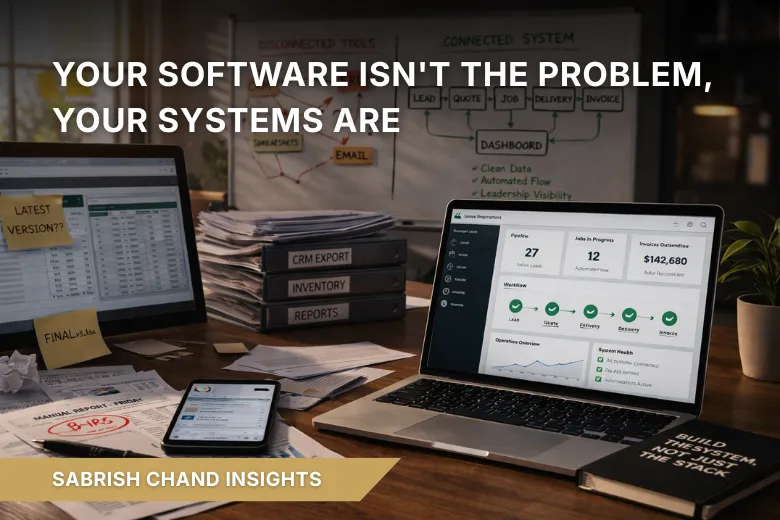
Why Your Software Isn't the Problem — Your Systems Are
I walked into a business last year and found six software tools that nobody used properly.
The team was still running reports manually. Copy-pasting between tabs. Emailing each other spreadsheets as the version of record. The owner had spent six figures over three years on software. He told me his biggest problem was adoption.
After one week on-site, I knew the truth. It wasn't an adoption problem. It was a build problem.
The Real Pattern Behind Failed Software Implementations
Here is what I see consistently in owner-operated businesses across Saskatchewan and Western Canada: tools get bought to solve isolated pain points. A CRM for sales. An ERP for inventory. A scheduling platform for operations. Project management software because someone read an article about it.
Every purchase makes sense in isolation. But nobody ever connects them to how the business actually runs. Nobody builds the machine that runs them.
So the tools sit there — technically functional, practically useless — while the team builds workarounds around the workarounds. Spreadsheets become the source of truth. Tribal knowledge fills the gaps. And the owner stays in the middle of everything because the systems can't function without him.
That's not a software problem. That's a systems problem.
The Difference Between a Tool and a System
A tool solves one isolated problem. A system connects your people, your data, and your decisions into something that actually runs the business.
Most businesses have tools. They've invested in them. The tools exist. But nobody has ever connected them to how the business actually flows — how a lead becomes a quote, how a quote becomes a job, how a job becomes a delivery, how a delivery becomes an invoice, how an invoice becomes a reconciled number in a report that leadership can trust.
When that chain isn't connected, the business leaks. Money. Time. Momentum. Every day.
A company I worked with in manufacturing had a quoting tool, a scheduling tool, an inventory system, and a billing platform. None of them talked to each other. The owner was manually reconciling data between all four every Friday afternoon. Four hours. Every week. For years. That's not a software problem. That's two hundred hours a year that should have been closed by a connected system.
Why Adoption Isn't the Problem
When a software implementation fails, the instinct is to blame adoption. The team didn't embrace the change. They reverted to old habits. They need more training.
Sometimes that's partially true. But adoption problems are almost always downstream of build problems.
People resist tools that don't fit how they actually work. They work around systems that create more friction than they eliminate. They go back to spreadsheets because the spreadsheet is honest and the software is a lie — it shows them a process that doesn't match their reality.
When I see an adoption problem, I start by asking: was this tool ever built to fit how this business actually runs? In most cases, the answer is no. It was configured to the vendor's demo. It was installed and handed over. Nobody went deep into the actual workflow and built around it.
That's the work most implementations skip. And it's the only work that actually matters.
What the BUILD Phase Actually Does
When I work with a business in the BUILD phase, we don't rip out what they have. We connect it.
We configure technology around how the business actually operates — not how it looked in the vendor demo, not how it runs theoretically, but how work actually flows through the people and systems that are there right now.
We eliminate the manual bridges. The copy-paste. The spreadsheet that lives in one person's email. The report that takes three phone calls to pull. We replace them with connected systems that surface the right information, at the right moment, to the right person — without the owner having to be in the loop.
Clean data that leadership can trust. Technology that fits how the business actually runs. Automation that sits inside operations instead of on top of them.
That's the difference between buying a tool and building a system.
Where to Start
If you recognise your business in this — if you've got tools that aren't delivering, workarounds that have become the actual process, or a team that's still running things manually despite significant software investment — the first step isn't another software evaluation.
The first step is a MAP.
Before anything gets built, you have to understand where the gaps actually are. Not where you think they are. Not where the last consultant said they were. Where they actually live — in the real flow of work through your real business.
That's what MAP is. And it changes everything that comes after it.
Find out where your business gap is.
→ assessment.sabrishchand.com/map-assessment-new


