
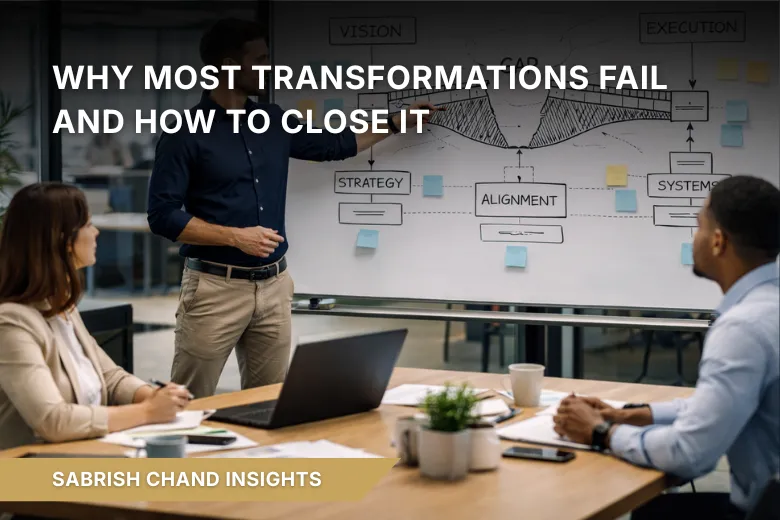
The Gap Between Vision and Execution: Why Most Transformations Fail and How to Close It
Most businesses I work with don't have a strategy problem.
The vision is clear. The leadership is capable. The intent is right. The planning sessions happened. The goals are on the wall.
What they have is a gap.
The space between what gets decided in the leadership meeting and what actually happens on Monday morning. Between the business they're building and the business that's running right now. Between the direction on the whiteboard and the reality in the systems.
That gap is where momentum dies. And it's where most transformations fail — long before they're ever called a failure.
Why the Gap Exists
The gap between vision and execution isn't a new problem. Leaders have been writing about it for decades. But understanding why it persists is the first step to actually closing it.
The most common assumption is that it's a strategy problem — that if leadership could communicate the vision more clearly, or build a better plan, the business would follow. So companies invest in strategy consultants, planning frameworks, and town hall presentations.
The gap stays.
The second assumption is that it's a people problem — that if you could hire better talent, incentivise more effectively, or build a stronger culture, execution would improve. So companies invest in HR initiatives, leadership development, and performance management systems.
The gap stays.
The gap stays because it's neither of those things. It's a systems and alignment problem. The infrastructure that's supposed to connect leadership decisions to operational reality is broken, disconnected, or simply never built. And no amount of better planning or better people can compensate for infrastructure that doesn't work.
What the Gap Actually Costs
The gap isn't abstract. It costs money every day — in real, measurable ways.
It costs time: hours spent reconciling information that should be automatic, meetings held to make decisions that should be systemic, manual work that exists because the systems don't connect.
It costs momentum: growth initiatives that stall because operations can't scale to support them, opportunities that get missed because the business can't respond fast enough, talent that leaves because capable people don't want to spend their careers working around broken infrastructure.
It costs confidence: leadership that can't trust their own data, owners who can't make clear decisions because they're looking at incomplete information, teams that don't believe the systems will support them so they stop trying to use them.
In the businesses I walk into, the gap is usually costing somewhere between 15 and 30 percent of operational capacity. Not in theory. In real hours, real rework, and real decisions made on incomplete information.
Why Most Transformations Fail to Close It
Transformation initiatives fail at a predictable rate for predictable reasons. Understanding those reasons is how you avoid repeating them.
The first failure mode is starting with solutions instead of diagnosis. A business identifies a pain — reporting is slow, communication is fragmented, decisions are inconsistent — and immediately starts evaluating tools to solve it. The tool gets bought, implemented, and six months later, the pain is still there in a slightly different form. Because the tool addressed a symptom, not the gap.
The second failure mode is treating transformation as a technology project. Technology is infrastructure — it enables the transformation, but it doesn't create it. Transformation requires changing how work flows, how decisions get made, and how the team takes ownership of outcomes. When the consultant hands over the system and leaves, none of that has happened.
The third failure mode is under-investing in the MAP phase. Most engagements want to move directly to BUILD. MAP feels slow. It feels like planning before doing. But a transformation built on an incomplete or inaccurate picture of where the business actually is will always drift back to its old shape.
You cannot build the right bridge if you don't know exactly where both shores are.
How MAP → BUILD → RUN Closes the Gap
MAP → BUILD → RUN is a three-phase framework built specifically around the gap between vision and execution. Every phase is designed to address one of the reasons transformations fail.
MAP starts with truth. We walk the business, trace how work actually flows, and find where the gap between the vision and the reality actually lives. Not where leadership thinks it is. Not where the last consultant said it was. Where it actually is — in the specific systems, decisions, and workflows of this specific business.
BUILD takes everything MAP uncovered and closes the gap systematically. We connect the systems that aren't talking to each other, eliminate the manual bridges, and configure technology around how the business actually runs. We don't rip out what's there. We build on it — and we build it to last.
RUN is the outcome most owners say they want and few actually achieve. We stay until the team owns it. Until the systems are trusted. Until the decisions that used to require the owner can be made without them. A business in RUN executes the vision — consistently, reliably, without depending on the owner to be in the middle of everything.
Three phases. One outcome: the gap, closed.
Where to Start
If you recognise your business in this — if there's a gap between where your business is and where it needs to go — the starting point is diagnosis, not solution.
Before any tools, any frameworks, any engagements: understand where the gap actually lives. What's disconnected. What's costing you. What's holding your vision at arm's length from your operations.
That's the MAP. And everything else builds from there.
Find out where your gap is — exactly.


