
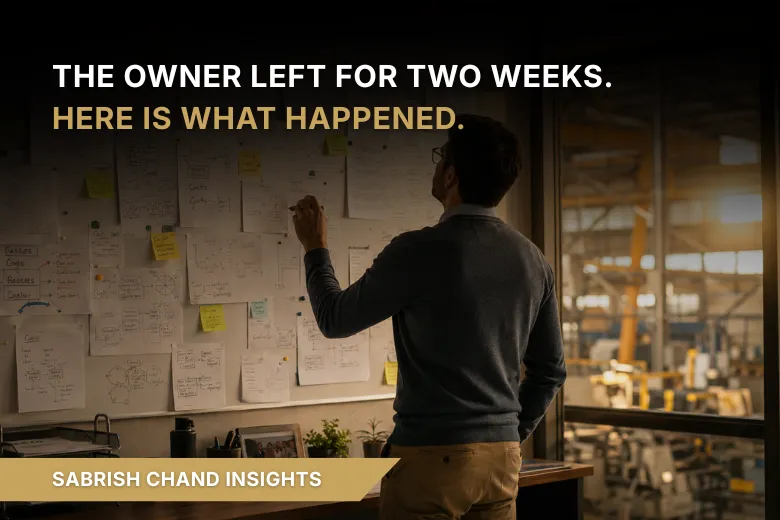
The Owner Left for Two Weeks. Here Is What Happened.
He had not taken a real break in four years.
Not a long weekend. Not a week where he checked in twice a day. A real two weeks where the business had to run without him in the loop.
He was not sure it could. Neither was I, six months earlier.
Where the Business Was Six Months Before
When I walked into this manufacturing business in Saskatchewan, every important decision ran through the owner.
Not because he designed it that way. Because the business had grown around his judgment. He made good calls. People learned to bring things to him. The systems were not built to carry those decisions anywhere else, so they defaulted to the person who always had the answer.
Client status questions required him. Supplier decisions required him. Scheduling conflicts required him. Approvals that should have been automatic required him.
He was not the owner of a business. He was the most critical component in it. And he knew it. Every holiday for four years had been interrupted. Every time he tried to step back, something broke.
A business that stops when the owner leaves is not a business. It is a dependency.
What the MAP Found
The first thing we did was map where the owner was actually in the middle of things.
Not where he thought he was. Where he actually was. Which decisions were routing to him by default. Which information only existed in his head. Which functions stopped when he was not available.
What the MAP surfaced was specific. Four core systems that did not talk to each other. The owner was manually bridging all four every Friday afternoon. A client status question required checking three of them and making a phone call. Approvals that should have had clear criteria were going to him because nobody had ever defined what should and should not require his sign-off.
None of this was his fault. It was a structural problem. The business was built around his availability, not around systems that could carry the load without him.
What the BUILD Looked Like
We connected the four systems. Not by replacing them. By building the integrations that let them share data automatically.
A confirmed quote created a scheduled job without anyone manually transferring the information. Job status was visible in one dashboard that anyone with access could read. The Friday reconciliation disappeared because the data moved on its own.
We mapped every decision that was routing to the owner and asked a simple question for each one: should this actually require him? In most cases the answer was no. We documented the criteria and assigned clear ownership.
Then we trained the team on the new structure. Not just how the systems worked. How to own the decisions that were now theirs to make.
What RUN Actually Means
RUN is the phase most engagements never deliver.
The system goes live. The consultant leaves. The team uses it for a few weeks. Then the real questions come. The edge cases nobody anticipated. The moments where the old way would have been easier.
Those moments need someone present. Not to make the decisions. To help the team build the confidence to make them.
We stayed. For the real questions. For the edge cases. For the moments where the team almost defaulted to the old way and needed someone to help them work through the new one instead.
Six weeks after go-live, the team was handling what came up without calling anyone.
What Happened When He Left
He took two weeks in August.
Things went wrong. They always do in a real business. A supplier delivered the wrong materials on day four. A client escalated a job status issue on day nine.
The team handled both. Without calling him. Without waiting for his sign-off. They had the information they needed, the authority to act on it, and the systems to support both.
He came back to a business that had run without him. Not perfectly. But cleanly.
That is the RUN outcome. Not an owner who disappears. An owner who finally gets to lead the business instead of running it.
If your business still needs you in everything, start here:
Start Your Assessment -> assessment.sabrishchand.com/
Ready to get inside the engine room? Book an Operations Audit:
Book an Operations Audit -> intheraconsultinggroup.com/3-day-business-audit


