
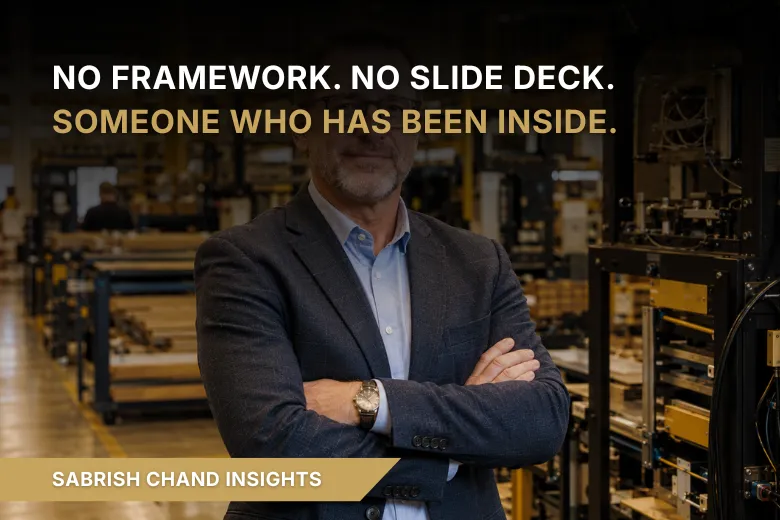
No Framework. No Slide Deck. Someone Who Has Been Inside.
Most owners I work with have already had the consultant experience.
The engagement that started with a thorough discovery phase. The workshops that aligned the leadership team. The analysis that was genuinely insightful. The presentation that was well-structured and clearly articulated.
And then the consultant left. And six months later, everything looked exactly the same.
Why the Plan Did Not Become Reality
The plan was not wrong. The strategy was sound. The priorities were right.
What failed was the space between the plan and the operation. The gap between what got decided in the boardroom and what actually happened on the floor. That space has no owner in most consulting engagements. The consultant owns the plan. The client owns the execution. And the actual work of bridging the two, of making sure the strategy lands in the systems and processes and decisions of the real business, belongs to nobody.
So it does not happen.
The team was expected to execute a transformation while still running the business. Without the systems to support the new way. Without the capability built into the operation to sustain what was designed. Without someone to stay long enough to make sure the real questions got answered and the real obstacles got removed.
Most consultants hand you a plan and disappear. The difference between a plan and a transformation is someone who stays until the business can run it.
What 25 Years Inside the Engine Room Actually Teaches You
I did not build my career in a consulting firm. I built it inside the places where strategy meets reality.
Manufacturing floors. Server rooms. Operations meetings where the real decisions get made, not the ones that make it into the slide deck. Businesses in transformation at every stage, from the initial diagnosis through the build to the moment the team finally runs what was created without needing someone from outside in the loop.
That experience taught me things no methodology captures.
It taught me that the formal version of a business is almost never how it actually runs. That the workarounds are not signs of failure. They are maps. They show exactly where the formal system has stopped keeping up with reality.
It taught me that technology is almost never the problem. The problem is the sequence. MAP first. Build second. Always. And never leave until the team owns what was built.
It taught me that transformation is not complete when the system goes live. It is complete when the team runs it without needing anyone from outside to tell them what to do.
These are not insights from a framework. They are patterns I have watched play out in businesses across every industry and company size for twenty-five years.
What No Templates and No Guesswork Actually Means
Every engagement starts with the truth about where the business actually is. Not where the strategy document says it should be. Not where leadership thinks it is. Where it actually is, in the real flow of work through the real systems that are running right now.
That means walking the business. Sitting with the people who do the work, not just the people who manage it. Tracing how a lead becomes a quote, how a quote becomes a job, how a job becomes a delivery, how a delivery becomes an invoice, how an invoice becomes a reconciled number in a report that leadership can trust.
It means finding the gaps where that chain breaks. Where data gets lost. Where manual work substitutes for a connection that was never built. Where decisions route through the owner because no system surfaces the right information to anyone else.
And it means building the specific solution for this specific business. Not a template. Not a best practice from another industry. The right answer for how this business actually runs, with this team, in this market.
Why Staying Matters
The step most engagements skip is the one that makes everything else last.
A system your team does not own will fail. It does not matter how well it was built. If the people running the business do not understand it, trust it, and own it, it becomes shelfware. The workarounds return. The spreadsheet comes back as the source of truth. And the engagement produced a document instead of a transformation.
Staying until the team owns it is not a service offering. It is the only way the work actually counts.
It means being present for the real questions, the ones that only come up when the team is using the system in actual conditions, not the training scenario. It means fixing what was not anticipated, because every deployment has gaps between what was designed and what reality requires. It means reinforcing the new way until it becomes the default, not because someone is watching, but because the team has experienced that it is better.
That shift does not happen at go-live. It happens in the weeks after. And it only happens when someone is still there.
No framework. No slide deck. Someone who has been inside and stays until the work is done.
Find out where your gap is:
Start Your Assessment -> assessment.sabrishchand.com/


